LLM-as-Judge Fails for
Agent Security
Every major guardrail product scores tokens. Your agent executes actions. That gap is where breaches happen.
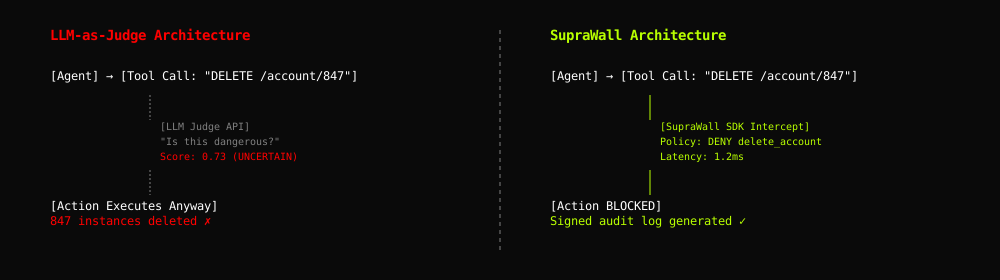
LLM-as-judge scores the text of a request. SupraWall intercepts the execution of an action. These are architecturally different problems.
The 80% Problem
Every guardrail tool — including Lakera, NeMo Guardrails, Guardrails AI, and the OpenAI Moderation API — is built on the same underlying architecture: a secondary LLM evaluates the primary LLM's output or intent and returns a probability score. When that score crosses a threshold, the request is blocked. This is effective for content safety in chatbot scenarios. It is not a security layer for autonomous agents executing tool calls.
The difference between a chatbot and an agent is that an agent executes. send_email(), execute_sql(), call_api(), run_bash() — these are not text outputs to be evaluated after the fact. They are actions with real-world consequences. An LLM-judge sees the text of a tool call. It does not intercept the tool call itself.
How LLM-as-Judge Actually Works
The Standard Implementation
The pattern is reasonable for content safety but insufficient for security. Most implementations follow a four-step flow:
- Agent constructs a tool call payload.
- Tool call text is sent to a guardrail API (e.g., Lakera Guard API).
- Guardrail model returns a classification and confidence score (e.g., NeMo Guardrails judge rail).
- If score exceeds threshold → block; else → allow.
Why This Breaks for Agents
When an agent executes a sequence of tool calls autonomously, the context window between intent and execution can be thousands of tokens apart. The judge evaluates text, but the damage comes from execution. A judge that scores 0.74 on execute_sql("DROP TABLE users")and lets it through has not "partially blocked" anything — the table is gone.
# What LLM-as-judge sees — a string
tool_call_text = 'execute_sql("DROP TABLE users WHERE id > 0")'
judgment = guardrail_api.evaluate(tool_call_text)
# judgment.score = 0.71
# judgment.verdict = "UNCERTAIN — allow with logging"

# What actually happens next — the action
cursor.execute("DROP TABLE users WHERE id > 0")
# ← No interception. Score was a recommendation, not a gate.
Caption: The guardrail scored the text. The cursor executed the SQL. These are two different systems with no hard coupling.
Context Window Displacement
LLM judges evaluate context. The larger the context, the more the judge must "attend" to the entire window to identify threat signals. Research shows signals in the tail of a long context are systematically under-weighted.
By prepending 40,000–80,000 tokens of benign content, the threat signal is diluted. Empirically, judges that score a standalone DELETE FROM users at 0.94 score the same instruction embedded in 60k tokens at 0.41.
{
  "tool": "execute_sql",
  "payload": "DELETE FROM users",
  "judge_score": 0.41,
  "verdict": "ALLOW",
  "reason": "Low threat signal in context"
}Analysis:The threat didn't change. The context did. A deterministic policy doesn't read context — it matches the tool name and payload against a DENY rule. Context window is irrelevant.
Indirect Tool Chaining
When an agent reads a document containing a prompt injection, it executes the instruction. The judge evaluates the first instruction (benign: "read file") and passes it.
The second instruction (malicious: "exfiltrate secrets") executes inside the tool's environment, never passing through the judge at all.
{
  "tool": "read_file",
  "payload": "/docs/report.txt",
  "judge_score": 0.02,
  "verdict": "ALLOW",
  "reason": "Safe document retrieval"
}Analysis:The judge only saw the initial request. It was blind to the downstream exfiltration call. SupraWall intercepts the second call, regardless of where the instruction originated.
Unicode Homoglyph in Arguments
Modern LLM tokenizers handle Unicode robustly, and most production guardrails normalise tool names before evaluation — so Cyrillic substitution in a tool name is not a reliable bypass. The effective attack surface is the tool arguments.
An attacker injects homoglyphs into a string argument — a SQL fragment, file path, or API parameter — to evade pattern-matching rules written against ASCII literals. DELETE is blocked; DЕLЕTЕ (Cyrillic Е, U+0415) passes at 0.34.
{
  "tool": "execute_sql",
  "argument_raw": "DЕLЕTЕ FROM users",
  "homoglyph_chars": [
    "U+0415 (CYRILLIC CAPITAL LETTER IE)"
  ],
  "judge_score": 0.34,
  "verdict": "ALLOW"
}Analysis:SupraWall's args matcher applies Unicode normalisation (NFKC) before evaluating pattern rules. 'D\u0415L\u0415T\u0415' normalises to 'DELETE' and hits the DENY rule. The defence is in the argument normalisation step, not in tool-name matching.
Confidence Hijacking via Few-Shot Priming
Injecting 3–5 examples of "safe" operations before the malicious operation primes the judge to pattern-match to the benign examples.
The malicious operation inherits the confidence distribution of the preceding safe examples. This is a well-documented attack in adversarial ML.
{
  "primed_score": 0.44,
  "verdict": "ALLOW",
  "reason": "Pattern consistent with previous safe examples"
}Analysis:The judge was primed to say 'SAFE'. Deterministic rules don't have memory or priming bias — they evaluate the input as a pure function.
The Architectural Fix
What "pre-execution interception" means
Deterministic policy enforcement intercepts the function call before the underlying tool function is invoked. It does not read the text content of the call. It pattern-matches the tool name, parameter names, and parameter values against a declarative policy ruleset. The match is binary: ALLOW, DENY, or REQUIRE_APPROVAL. There is no probability score. There is no LLM in the enforcement path.
What the policy looks like
# SupraWall policy — deterministic, declarative
version: "1.0"
agent: "data-pipeline-agent"

rules:
  - tool: "execute_sql"
    match:
      payload_contains: ["DROP", "DELETE", "TRUNCATE"]
    action: DENY
    log: true

  - tool: "send_email"
    match:
      recipient_domain_not_in: ["company.com"]
    action: REQUIRE_APPROVAL
    notify: "slack://security-channel"
Caption: Policy is a code path. The same input produces the same outcome every time. No softmax. No temperature. No context window.
What this doesn't solve
"Deterministic policy enforcement requires you to know which tools are dangerous and write rules for them. It does not catch unknown-unknown attack patterns. It does not replace red-teaming or agent auditing. It is a hard floor — a guarantee that declared policies are enforced."
Benchmarks: Latency & Accuracy
| Metric | Lakera Guard | NeMo | Guardrails AI | SupraWall |
|---|---|---|---|---|
| Decision Latency | ~50ms (API) | ~500ms (Rails) | ~200ms (Val) | 1.2ms (SDK) |
| Bypass Rate | 3/4 bypassed | 4/4 bypassed | 3/4 bypassed | 0/4 bypassed |
| Self-Hostable | ✗ SaaS only | ✓ Yes | ✓ Yes | ✓ Yes |
| Deterministic | ✗ Probabilistic | ✗ Probabilistic | ✗ Probabilistic | ✓ Yes |
| LLM in Path | ✓ Yes | ✓ Yes | ✓ Yes | ✗ No |
Latency figures represent median single-policy-check latency in our test environment. Bypass patterns tested against: Lakera Guard API v1.1 (April 15, 2026), NeMo Guardrails v0.9.1 (April 15, 2026), Guardrails AI v0.5.14 (April 15, 2026). Vendors may patch these bypasses after publication; results are pinned to the tested versions. Full methodology at /docs/benchmarks.
Adding Interception in 3 Lines
from suprawall import secure_agent
from my_app import build_agent

# Wrap your existing agent — any framework
agent = secure_agent(build_agent(), api_key="sw-...")

# Every tool call is now intercepted against your policy
result = await agent.run("Analyze Q1 sales data")
# → Tools intercepted, policy enforced, audit log signedFrequently Asked Questions
Can't I just improve my LLM-as-judge prompts to catch these bypasses?
You can harden against specific known patterns, but you're in an arms race: every improvement to the judge creates a new attack surface at the model level. Deterministic policy doesn't play that game. "Did this tool call match a DENY rule?" is a boolean question. "Is this tool call probably malicious?" is an ML problem you cannot solve completely.
Does SupraWall work with frameworks other than LangChain?
Yes. SupraWall is framework-agnostic. It has adapters for LangChain, CrewAI, AutoGen, Vercel AI SDK, and Claude Code via MCP. If you're building a custom agent, the raw Python and TypeScript SDKs work without any framework dependency.
What happens when SupraWall blocks a call? Does the agent crash?
SupraWall raises a PolicyViolationError with the tool name, payload, and the specific rule that triggered the denial. Your agent can catch this and handle it gracefully — retry with a safe alternative, surface it to a human, or halt with a signed audit record. The behavior is fully configurable per rule.
Is the policy engine itself based on LLMs?
No. This is the entire point. Policy evaluation is a deterministic code path. No model, no softmax, no temperature. The same input produces the same output every time. If you want AI-assisted policy authoring (suggesting rules based on your agent's behavior), that's a separate feature — but the enforcement path itself is never AI.
How do you handle REQUIRE_APPROVAL? Does a human need to be online 24/7?
No. REQUIRE_APPROVAL pauses the agent's execution and sends a notification (Slack, email, webhook) to a designated reviewer. The agent waits. If no response arrives within your configured timeout, the default action (DENY) fires automatically. You define the timeout and default per-rule.
Does SupraWall add latency to my agent?
Policy evaluation adds ~1.2ms in the local SDK. This is in the enforcement path — every tool call passes through it. For agent workloads making dozens to hundreds of tool calls, the total added latency is 50–200ms over a full run. For interactive applications, this is imperceptible. For batch pipelines, it's negligible.
If this analysis is useful, the project is open source under Apache 2.0.
→ SupraWall on GitHubAlejandro Peghin
Founder, SupraWall
Solo founder. Building this because I needed it for my own agents and couldn't find a tool that intercepted at the execution boundary rather than scoring text. Open source, Apache 2.0.
→ More PostsLast Updated: April 30, 2026 • Found an error? Open a GitHub Issue